

Palm sugar for bakeries
A practical guide for bakery buyers and product developers: what arenga palm sugar is, how it behaves in dough and in the oven, how to swap it for cane sugar, and how we supply it in bulk from Indonesia.
Last updated
1:1
Swap by weight
Replaces brown or white sugar gram for gram in most cookies, cakes and fillings.
What arenga palm sugar is
Gula semut aren, as it is called in Indonesia.
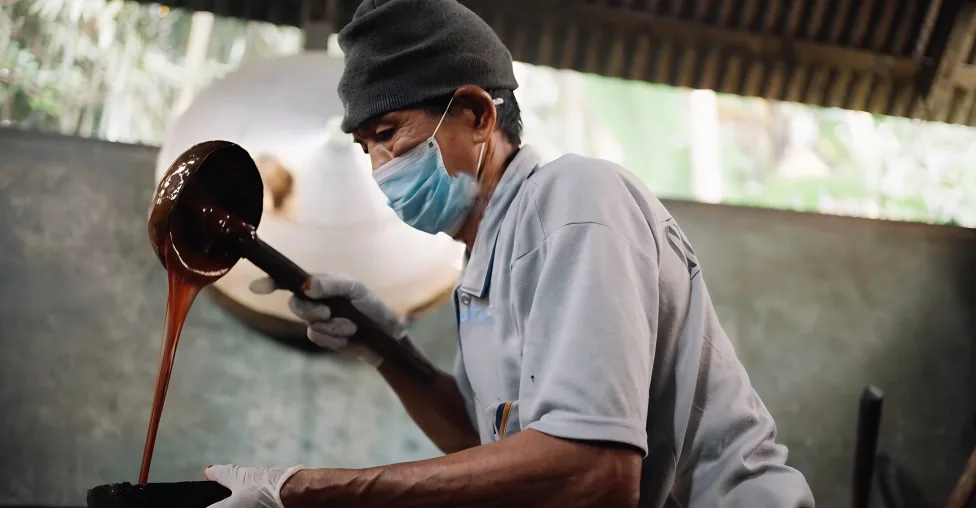
Arenga palm sugar comes from the sap of the sugar palm, Arenga pinnata. Farmers in Sumatra and Java climb the palm and tap the flower stalk by hand, usually twice a day. The sap is filtered and boiled down in open pans until it thickens, then dried, milled into granules and sieved to size.
Nothing is added and nothing is refined out. The minerals and the small amount of natural invert sugar in the sap stay in the sugar, which is why it tastes of caramel and toffee rather than plain sweetness, and why it bakes slightly differently from white sugar.
It is a different palm from coconut sugar, which is made from coconut blossom sap. Both are sold as "palm sugar". Arenga has the deeper, smokier caramel note; coconut sugar is milder. Compare the two.
How it compares with other sugars
Figures for the two palm sugars are from our own lab reports.
| Arenga palm sugar | Coconut sugar | Brown sugar | White sugar | |
|---|---|---|---|---|
| Made from | Arenga palm sap, boiled and granulated | Coconut blossom sap, boiled and granulated | Refined cane or beet sugar with molasses | Refined cane or beet sugar |
| Flavor | Caramel, toffee, slightly smoky | Mild caramel | Molasses | Neutral sweet |
| Color in bakes | Golden to medium brown | Golden brown | Golden to dark brown | Pale |
| Total sugar as sucrose | 91.38% | 92.76% | - | Close to 100% |
| Reducing sugars | 3.11% | 2.51% | - | Trace |
| Moisture | 1.50% | 0.83% | Moist, packs firmly | Very dry |
| Typical swap | 1:1 for brown or white sugar | 1:1 for brown or white sugar | - | - |
Arenga: Sucofindo Laboratory, Batam, report of October 2026. Coconut sugar: MBRIO Food Laboratory, Bogor, report of August 2026. Single samples; each lot ships with its own COA.
How it behaves in dough and in the oven
What bakers notice in their first trial batch.
Browns a little sooner
Reducing sugars take part in the Maillard reaction and caramelize at lower temperatures than sucrose. Crusts, cookie edges and cake tops color faster. Many bakers shorten the bake slightly or lower the oven by about 10 °C on the first trial.
Keeps bakes moist for longer
Like brown sugar, palm sugar holds on to water, so soft cookies, brownies and cakes stay tender a day or two longer. The sugar itself is dry (max 2.0% moisture), so it doses like granulated sugar.
Same sweetness by weight
With total sugar above 90%, a one-to-one swap by weight keeps the sweetness of your recipe close to the original. Taste may read as less sharp because of the caramel notes.
Spread and texture
In cookies, palm sugar behaves much like brown sugar: a little more spread and chew than with white sugar. Chill the dough if you want thicker cookies.
Swap guide by product
A starting point for your first trial. Adjust after tasting.
| Product | Swap | What to watch |
|---|---|---|
| Chewy cookies, brownies | 100% of brown sugar | Bake color; pull a minute earlier if edges darken |
| Banana bread, carrot cake, spiced cake | 100% of brown or white sugar | Darker crumb, stronger caramel flavor |
| Butter cake, muffins | 50 to 100% of white sugar | Use finer mesh when creaming with butter |
| Granola, cereal bars | 100% of sugar in the binder | Bars set a little softer; check after cooling |
| Caramel sauce, fruit fillings | 100% | Dissolves fully during cooking |
| White meringue, light sponge, icing | Not recommended | The color shows; keep white sugar or swap only part |
Choosing the granulation
Mesh is the number of sieve openings per inch; a higher number means finer sugar.
| Mesh | Opening | Best for |
|---|---|---|
| 16 | 1.18 mm | Toppings and sprinkling, where visible crystals are wanted |
| 18 | 1.00 mm | Doughs, batters, fillings, granola |
| 20 | 0.85 mm | General bakery use; dissolves well in batters |
| Finer than 20 (up to 22) | below 0.85 mm | Creaming with butter, fine-crumb cakes, dry mixes |
Openings follow the US standard sieve series. Our standard is mesh 16 to 20; finer milling is available on request.
Laboratory results
Typical analysis of our arenga palm sugar.
| Parameter | Result |
|---|---|
| Moisture | 1.50% |
| Ash | 1.21% |
| Reducing sugar | 3.11% |
| Total sugar as sucrose | 91.38% |
| Lead, cadmium, mercury, arsenic | Below detection limit |
| Aerobic plate count | 1.0 × 10² CFU/g |
| Yeast and mold | 4.0 × 10¹ CFU/g |
Sucofindo Laboratory, Batam, Report of Analysis No. 141/36.30/1515/09/2026/1, methods SNI 3743:2021 and SNI ISO. Full results are in the spec sheet.
Running a trial batch
The quickest way to decide is a side-by-side bake. This is the routine we suggest to bakery buyers.
Bake two batches the same day
Use one best-selling recipe. Bake it once with your current sugar and once with palm sugar at the same weight, same oven, same time.
Compare four things
Color out of the oven, spread or rise, softness after one and three days, and taste with a small panel of staff or customers.
Want to try coconut sugar in the same test? We can send both in one sample parcel. See coconut sugar.
Storage and handling
Keep it closed
Palm sugar picks up moisture from humid air. Close the PE liner after each use and keep sacks off the floor on pallets.
Shelf life
24 months in sealed packing. Use first-in, first-out across lots.
If lumps form
Soft lumps from humidity break apart by hand or through a sieve. They do not affect quality.
Packing for bakeries
Bulk for production lines, smaller packs for distributors.
25 kg paper sack
Multi-wall paper sack with a food-grade PE inner liner. 14 to 15 MT per 20 ft container on pallets.
10 or 20 kg carton
PE bag inside a master carton, easier to handle in smaller bakeries.
Private label
Kraft pouches of 250 g, 500 g or 1 kg with your design, for bakery supply shops and retail.
From trial batch to container
Minimum order 5 MT. FOB Tanjung Priok, CIF on request.
- Free sample
Tell us what you bake and which mesh you need. The sample is free and ships by express with its spec sheet and COA. You pay only the courier cost.
- Trial batch
Bake it side by side with your current sugar. We answer questions on granulation and moisture.
- Quotation
In USD, valid 14 days. T/T or L/C.
- Production and shipment
Produced and packed in 2 to 3 weeks, shipped with its COA and export documents.
Questions from bakers
Yes, by weight. Expect a similar or slightly darker color and a caramel, toffee-like flavor. Check bake color on the first batch, because palm sugar browns a little sooner than white sugar.
In most cookies, cakes, quick breads and fillings, yes, gram for gram. The result is darker and more caramel in flavor. For white meringues, light sponges or icing, where a pale color matters, keep white sugar or use a partial swap.
A finer grind dissolves faster when creamed. Our standard is mesh 16 to 20, and finer milling up to mesh 22 is available on request. For doughs, fillings and sauces, the standard grind is fine.
Palm sugar takes up moisture from humid air, like brown sugar. Keep the liner closed and store it in a cool, dry place. Soft lumps break apart easily; sieve before dosing if needed.
5 MT per order. A 20 ft container holds 14 to 15 MT on pallets, or up to 18 MT floor-loaded.
Yes. The sample is free and ships by express with its specification sheet and COA. You pay only the courier cost, on your DHL, FedEx or UPS account or by our quote before we send it.
Bake a trial batch with it
We send a free sample of arenga palm sugar with its spec sheet and COA. You pay only the courier cost.